
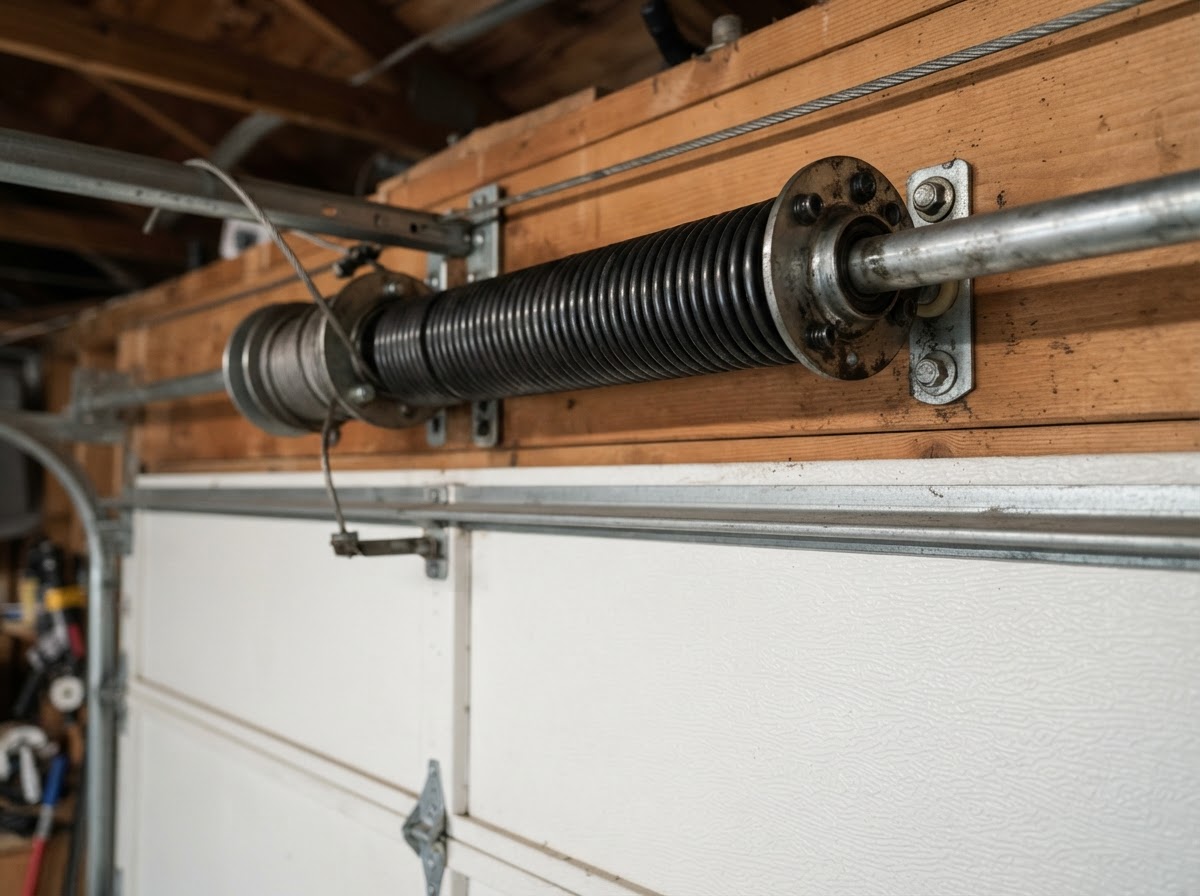
Garage door springs do most of the heavy lifting. They're under a great deal of tension, and when one breaks, the door can become difficult or impossible to open. This guide covers the warning signs of a broken or damaged spring, the safety precautions that matter most, and why spring replacement is a job for a trained professional — not a DIY project. If you're in Pasadena, Texas, or a nearby community, this will help you recognize the problem and know what to do next.
Common signs of a broken or damaged spring
Springs usually don't fail silently. The signs below are the ones homeowners notice most often:
- A loud bang from the garage — springs release a lot of stored energy when they break.
- A visible gap in the coiled spring, where the metal has separated.
- A door that feels extremely heavy to lift manually.
- A door that won't open at all, or opens only a few inches.
- A door that opens unevenly or appears crooked when one spring of a pair has broken.
- The opener straining or humming without moving the door.
If you notice any of these, the safest response is to stop using the door and contact a professional. See our broken garage door spring replacement page for more on the service.
broken garage door spring replacement
Why the door becomes hard or impossible to lift
Without a working spring, the opener and you are left to lift the full weight of the door. Garage doors are heavy, and a broken spring means that weight is no longer counterbalanced. That's why a door that worked fine yesterday suddenly feels impossibly heavy or won't move at all today. Trying to force it — by hand or with the opener — can damage the opener, the door, or the tracks, and can create a safety risk.
Observing a problem vs. attempting a repair
There's an important difference between noticing that a spring is broken and trying to fix it yourself. Recognizing the warning signs and calling a professional is exactly the right thing to do. Attempting to remove, adjust, or replace a spring yourself is dangerous, even if the spring appears broken and 'relaxed.'
If you can see a gap in the spring or the door won't lift, that's enough information to stop and call for help. You don't need to touch the spring to know it needs a professional.
The risks of high-tension spring systems
Garage door springs — particularly torsion springs — are under extreme tension. That tension is what makes the door easy to lift, and it's also what makes the springs dangerous to handle. Torsion springs have caused serious injuries when improperly adjusted or released. The winding cones, cables, and anchor hardware all hold stored energy that can release suddenly and forcefully.
Because of this risk, spring adjustment and replacement require specific tools, training, and safety procedures. This is not a matter of being careful — it's a matter of having the right equipment and experience.
Why spring replacement isn't a DIY job
We're sometimes asked whether a homeowner can replace a spring themselves to save time or cost. Our answer is straightforward: no. The risk of serious injury from a high-tension spring is real, and the tools and procedures required aren't something most homeowners have or can safely learn from a guide. This is why we don't provide step-by-step instructions for removing or adjusting springs.
A professional has the correct winding bars, clamps, and safety equipment to release and reinstall the spring safely. The cost of professional replacement is small compared to the risk of handling a torsion spring without proper training.
What to do if the door seems unstable
If a door with a broken spring appears unstable, sagging, or off-balance, treat it the same way you'd treat an off-track door: stop using it, keep people and pets away, and don't try to force it open or closed. A door that's heavy on one side or crooked can shift unexpectedly.
If you can, disconnect the opener (using the emergency release only if it's safe to do so and the door is fully closed) and leave the door as-is until a professional arrives. If the door is stuck open, don't try to lower it yourself — a broken spring means the door can fall.
What to tell us when you request help
When you contact a professional, these details help them come prepared:
- Whether you heard a bang and roughly when.
- Whether you can see a gap in the spring.
- Whether the door opens at all, and how far.
- Whether the door is stuck open or closed.
- Whether the opener runs but the door doesn't move.
With that information, a technician can bring the right spring and tools. We also handle the broader door issues that sometimes accompany a broken spring — see our garage door repair and installation page.
garage door repair and installation
We serve Pasadena and the surrounding communities from our Pasadena location. See our Pasadena service area page for more about the area we cover.
garage door repair in Pasadena
If you suspect a broken spring, don't wait — stop using the door and request an estimate through our form, or call Royal Garage Door Repair at (346) 873-2381. We're open 24/7.